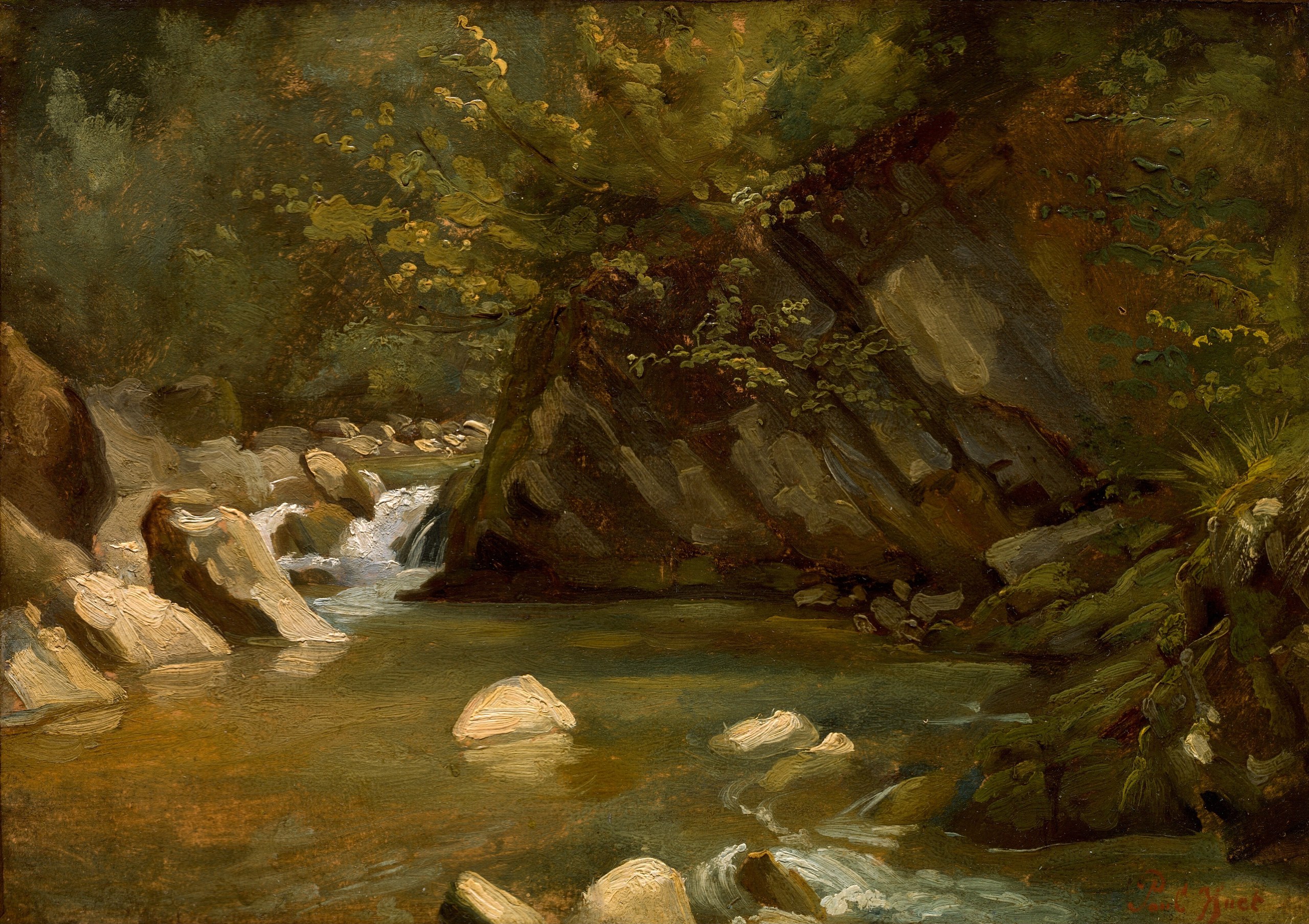
About this work
The Lorette River is a tributary of the Saint-Charles River, crossing the sector Sainte-Foy, Sillery, Cap-Rouge and the area of L'Ancienne-Lorette in Quebec City, in the administrative region of Capitale-Nationale, in the province of Quebec, Canada. The Lorette river valley is mainly served by various urban roads, notably the route 358 (avenue Notre-Dame), boulevard Chauveau Ouest, rue Saint-Olivier, rue Saint- Jean-Baptiste, rue Saint-Paul, route 138 (boulevard Wilfrid-Hamel), boulevard du Parc-Technologique and boulevard Masson. The surface of the Lorette River (except the rapids areas) is generally frozen from the beginning of December to the end of March; safe circulation on the ice is generally done from the end of December to the beginning of March.
About Paul Huet
Paul Huet was a French painter and printmaker born in Paris. He studied under Gros and Guerin. He met the English painter Richard Parkes Bonington in the studio of Gros, where he studied irregularly from 1819 to 1822. Bonington's example influenced Huet to reject neoclassicism and instead paint landscapes based on close observation of nature. The British landscape paintings exhibited in the Salon of 1824 were a revelation to Huet, who said of Constable's work: "It was the first time perhaps that one felt the freshness, that one saw a luxuriant, verdant nature, without blackness, crudity or mannerism." Huet's subsequent work combined emulation of the English style with inspiration derived fro
Where it hangs
Woodland Stream is in the collection of National Gallery of Art.